Cold-Exposure Torture
Guantanamo DiaryCold-Exposure Torture was one element of the interrogation and isolation imposed on Mohamedou Ould Slahi at Guantánamo. In his account, cold was not an incidental discomfort but a controlled condition woven into a wider regime: the cell was kept cold, access to daylight and ordinary contact was restricted, and interrogations continued around the clock. Later official investigations documented the special interrogation plan and its staged transfer procedures, lending support to the broader account while leaving some details of the censored manuscript unresolved.
Cold within the interrogation regime
After Slahi entered an isolated block, he describes losing nearly all of his ordinary belongings. He had only a thin sleeping mat and a small, worn blanket; his books, Quran, soap, toothpaste, and toilet paper were removed. The cell was cooled until he was frequently shaking. He was kept from daylight, and recreation was sometimes scheduled at night to prevent contact with other detainees. These conditions formed a single system: the cold cell, restricted surroundings, and isolation were not presented as separate inconveniences but as overlapping pressures.
The interrogation schedule intensified that pressure. Slahi says that for seventy days he could not sleep properly because questioning continued twenty-four hours a day, sometimes across three or four shifts, with few days off. Interrogators repeatedly made sleep and hot meals conditional on cooperation. Guards also banged on his cell and woke him, while Slahi believed that they were acting in coordination with the interrogators. Cold exposure therefore operated alongside disrupted sleep and recurring uncertainty about when questioning would resume.
The account also describes brief changes in temperature as part of the experience of confinement. When Slahi was escorted from his cold cell to an interrogation room, the warmth of the Guantánamo sun could briefly feel like a return to ordinary life. He describes that relief as temporary, followed by the knowledge that he would soon be back in the same conditions. The contrast makes warmth a short-lived reprieve rather than an escape from the regime.
The cold room and its operation
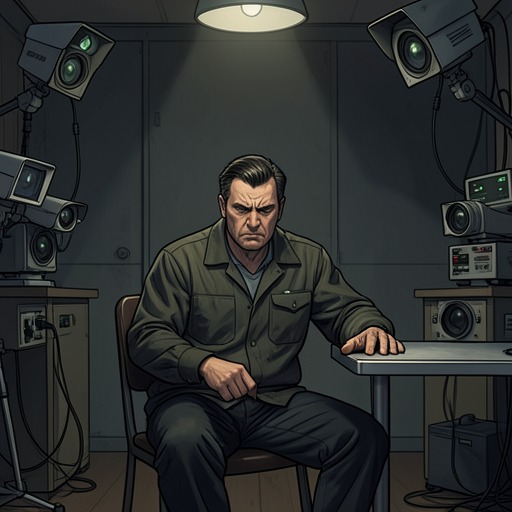
Slahi describes interrogators lowering an air conditioner to make an interrogation room extremely cold. He gives the room’s temperature as 49 degrees Fahrenheit, or 9.4 degrees Celsius, and says that detainees could remain there for more than twelve hours in a thin uniform, without underwear. He notes that the interrogators were dressed for the cold and did not remain in the room continuously: they could enter for questioning or humiliation and then leave for an adjoining monitoring room. The unequal exposure is central to his description of the method.
He also reports being restrained in a way that prevented some of his usual movements, including rubbing his hands. His account links this restriction to how he responded when nervous, rather than presenting the restraint as a neutral security measure. In another episode, an interrogator poured ice-cold water over his clothes; another person intervened and the pouring stopped. Slahi understood that intervention as concern about the paperwork that might follow if he died. The episode shows how cold could be imposed through more than one procedure, although the manuscript’s redactions conceal some identities and particulars.
Slahi says that freezing-room practices had been used at the camp since at least August 2002 and that many detainees had experienced them. He also describes the possible consequences as delayed, while the surviving passage does not provide a complete, unredacted account of those effects. That distinction matters: his description conveys a fear that harm could become apparent later, but the censored text does not establish a specific medical outcome for every person exposed.
Cold, isolation, and religious practice
The cold room appears within a broader pattern of sensory and social restriction. In a specially prepared room, Slahi describes cold conditions, images of United States military power, and music played through the night. He reports being told not to pray while the United States national anthem was playing and says that he eventually prayed silently. His account thus connects the control of the physical environment with attempts to regulate religious practice. Cold was one part of an environment in which sound, light, contact, and the ability to pray could also be constrained.
A later staged transfer extended the use of disorientation and reduced external stimuli. The Senate Armed Services Committee found that the military’s special interrogation plan included a simulated removal from the island, followed by placement in a sealed, trailer-like isolation hut at Camp Echo. The plan called for limiting light and visible surroundings and using speakers for sound. The Department of Justice inspector general reported that an intended helicopter deception was abandoned as impractical; on August 25, 2003, Slahi was instead taken on a disorienting boat ride with blackout goggles. These documented measures are not identical to cold exposure, but they help place the cold room within a plan that deliberately manipulated the conditions under which a detainee experienced confinement.
Testimony, records, and uncertainty
The published account is not the only source describing the interrogation program. In 2003, military prosecutor Stuart Couch received intelligence reports from Slahi and learned that he had been assigned to special projects. Couch had seen another detainee in an interrogation booth under harsh sensory conditions and suspected that Slahi’s reported intelligence had been obtained through abusive methods. An investigator later gained access to interrogators’ files, including daily memoranda that recorded both what was said and how information was extracted.
Those files remain classified, but the Senate Armed Services Committee’s 2008 inquiry and the U.S. Department of Justice’s 2008 review summarized the special interrogation and compared it with Slahi’s description. Couch concluded, after examining documents that included a fabricated letter about Slahi’s mother and an exchange about Slahi hearing voices, that Slahi had been tortured. These records support the existence of a planned, documented interrogation operation; they do not make every redacted passage in the manuscript independently verifiable.
The editorial notes accompanying the manuscript make that limit explicit. They explain that their annotations draw on context, material elsewhere in the manuscript, and public records, but do not claim to reconstruct the original redacted text or reveal classified information. Cold-Exposure Torture is therefore presented through a combination of Slahi’s detailed account and official documentation of the surrounding plan, with an important boundary between corroborated procedures and details obscured by censorship. That boundary is part of the subject itself: the account describes controlled exposure to cold, while the black bars mark what readers still cannot see.